01 Science in the Court Room
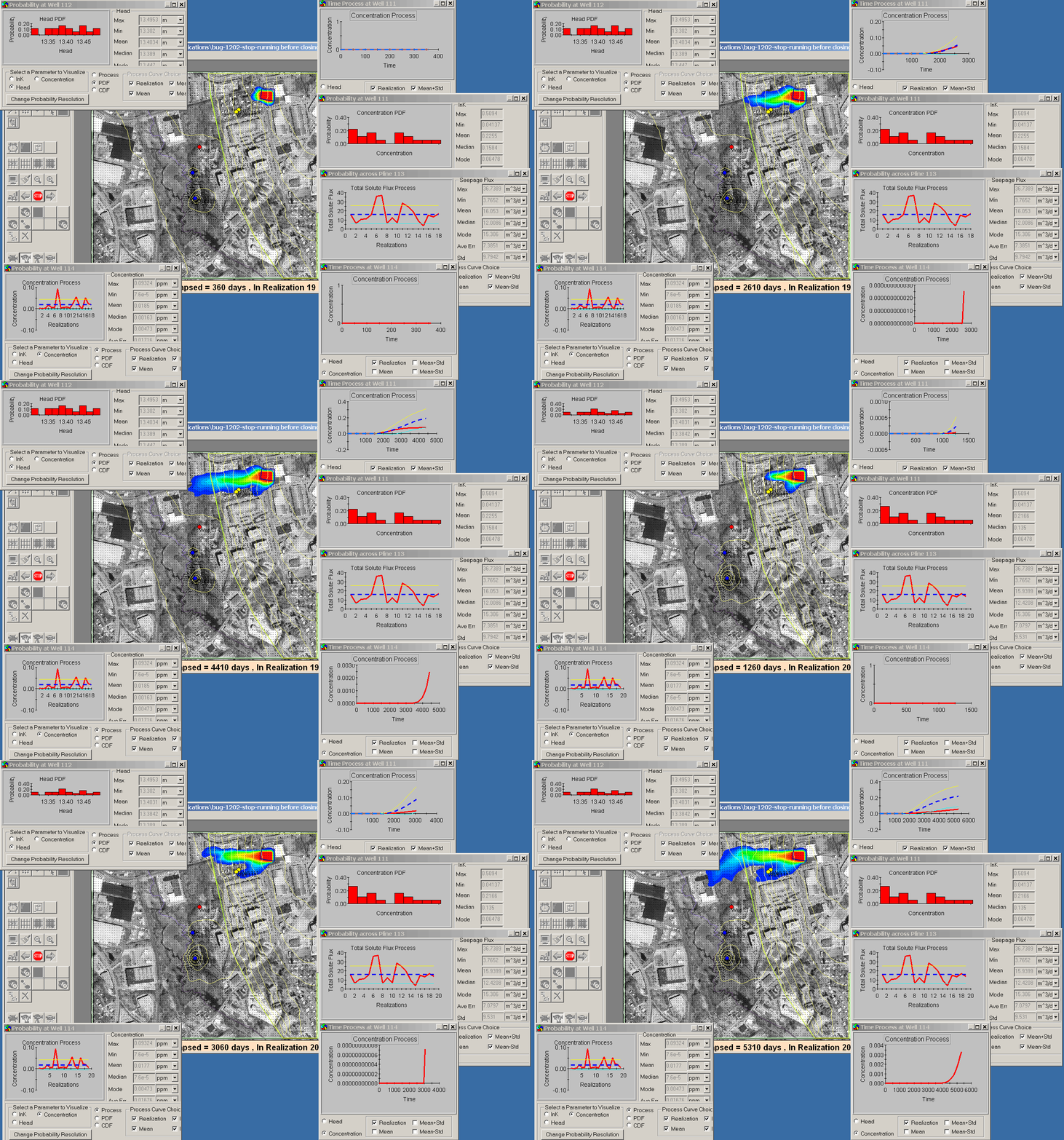
Can a town prove that an industrial solvent in its drinking-water wells came from a particular factory?
What you’re watching A town’s water-supply wells drawing in a contaminant plume that started up-gradient — the sources, the plume, and the capture all unfolding together.
The mechanism This is the ‘A Civil Action’ / Woburn scenario: students act as expert witnesses, using simulation to test whether a plume from a suspected source could actually reach the wells, and when. They must reason from incomplete data, just as real litigation demands.
Why it matters It turns abstract transport into a courtroom argument: students build, defend, and challenge an evidence-based case, confronting uncertainty and the limits of what a model can prove.
IGW-NET Running the contamination-to-well scenario live lets students test competing theories of the case in minutes — the inquiry at the heart of forensic hydrogeology.
02 Well Dynamics
What really happens around a well — and to its neighbors — when you start pumping?
What you’re watching Several wells pumping at once, their cones of depression overlapping and interfering as the wellfield responds over time.
The mechanism Students vary pumping rates, spacing, and aquifer properties and watch drawdown grow, cones overlap, and wells interfere — discovering the dynamics rather than being told them.
Why it matters An open-ended way to build intuition for well behavior, interference, and water conflicts before any equations — after which the equations make sense.
IGW-NET Real-time pumping experiments let students pose ‘what if’ questions and see the aquifer answer immediately.
03 Open-ended Inquiry & Conceptual Modeling
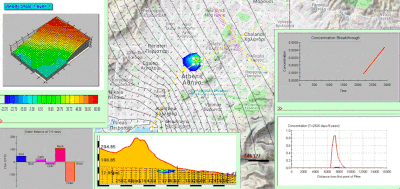
How do you turn an open-ended, real-world question into a working groundwater model?
What you’re watching A real-site investigation shown as a live dashboard — a 3D conductivity surface, a map of the area with the flow field and contaminant source, and concentration breakthrough and profile plots — several threads of analysis pursued at once.
The mechanism Students take on the central, open-ended modeling judgment: from limited data, choose the structure, boundaries, and heterogeneity, then test the conceptual model against observations such as breakthrough curves. There is no single scripted path — the inquiry proceeds nonlinearly, looping between hypothesis, simulation, and data.
Why it matters It teaches modeling as genuine inquiry: forming and revising hypotheses, integrating many kinds of evidence, and staying honest about what remains uncertain.
IGW-NET Pursuing a real, multi-faceted investigation — conductivity, flow, breakthrough, and profiles together — makes the open-ended, nonlinear nature of conceptual modeling the lesson itself.
04 Designing Cleanup Schemes
You are handed a contaminated aquifer and a budget — how would you clean it up?
What you’re watching A pump-and-treat system: an extraction well’s capture zone forming and drawing the plume in for treatment.
The mechanism Students design a remedy — well placement, pumping rates, perhaps a barrier — then run it and see whether the capture zone actually contains the plume and how long cleanup takes.
Why it matters Open-ended engineering design: students iterate, fail, and improve, learning why real remediation is hard and costly.
IGW-NET Designing and immediately testing a cleanup scheme turns students into engineers running their own pilot studies.
05 Experience the Scale Effects
Why does a plume seem to spread faster the longer and farther it travels?
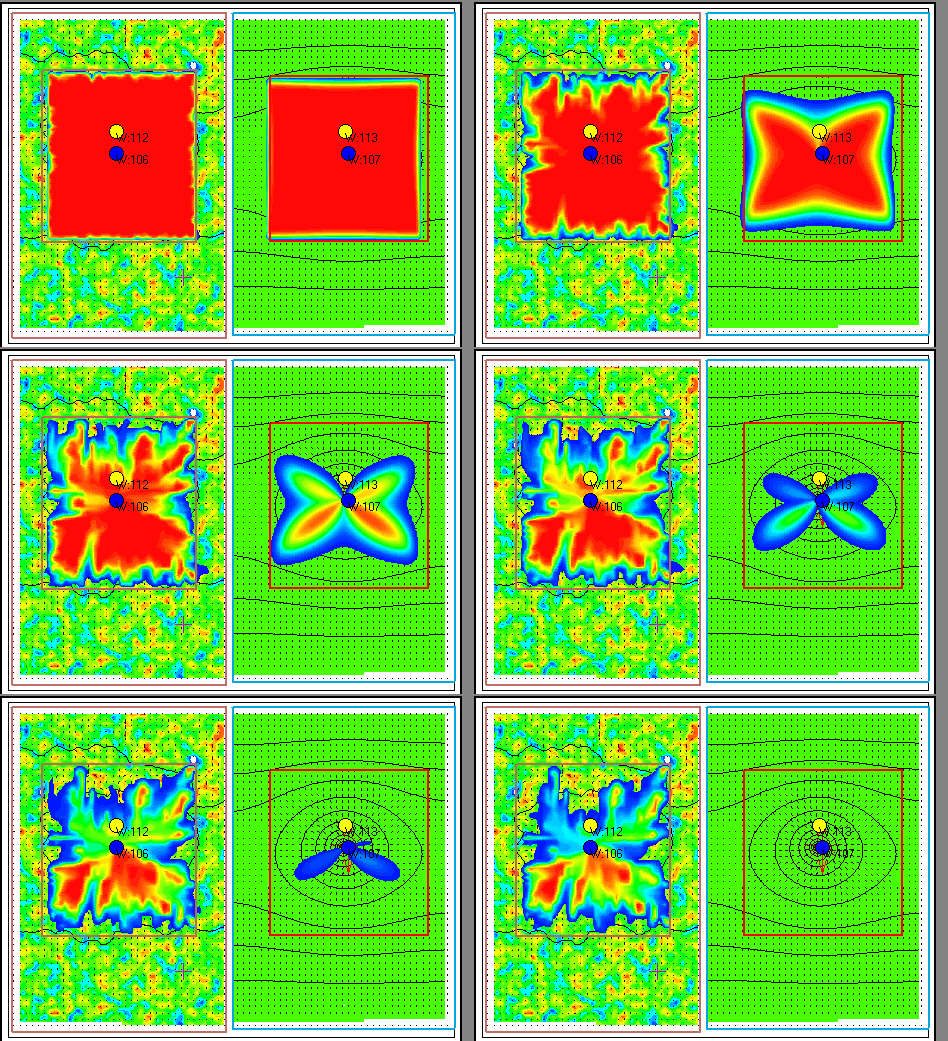
What you’re watching An aquifer rendered at one, two, and three nested scales of heterogeneity — the plume fragmenting further as each scale is added.
The mechanism Students add scales of heterogeneity and watch dispersion grow with travel distance — experiencing scale-dependent dispersivity instead of memorizing that it exists.
Why it matters It makes one of hydrogeology’s most confusing facts — scale-dependent dispersivity — intuitive and memorable.
IGW-NET Toggling scales and watching the plume respond lets students discover scale effects for themselves.
06 Visualizing Nonideal Transport
Does a real plume actually look like the neat bell-shaped curve of the textbook?
What you’re watching A real heterogeneous plume — fingered and channelized — beside the smooth, symmetric plume an effective model predicts.
The mechanism Students compare ideal (Fickian) transport with real heterogeneous transport and see the fingering, channeling, and tailing the smooth model misses.
Why it matters It confronts students with the gap between textbook transport and reality, motivating why heterogeneity matters.
IGW-NET Seeing the real and idealized plumes side by side makes ‘non-ideal’ transport concrete and unforgettable.
07 Understanding the Limitation of Pump and Treat
Pump long enough and the plume is gone — so why does cleanup drag on for decades?
What you’re watching Pump-and-treat in a heterogeneous aquifer: the bulk plume flushes quickly, but contamination lingers, trapped in low-permeability pockets.
The mechanism Students watch the easy mass leave fast while trapped mass slowly back-diffuses — discovering the tailing that defeats simple cleanup, rather than being told cleanup is ‘hard.’
Why it matters It builds realistic expectations: why pump-and-treat underperforms, and why predictions of ‘clean by next year’ so often fail.
IGW-NET Running a cleanup to its frustrating, slow tail teaches the limitation viscerally.
08 Challenges in Predicting Plume in Variable Media
Given the same data, would two experts predict the same plume?
What you’re watching The smooth ensemble-mean plume beside a single fingered realization — the average looking nothing like any real outcome.
The mechanism Students generate many equally-likely aquifers and watch the plume differ each time, confronting the irreducible uncertainty of prediction in heterogeneous media.
Why it matters It teaches humility and probabilistic thinking: predictions need uncertainty bounds, not false precision.
IGW-NET Watching realizations diverge from identical statistics makes the case for probabilistic prediction first-hand.
09 Interacting Heterogeneity
What happens when the chemistry and the geology vary together?
What you’re watching A reactive plume run with the sorption coefficient positively, negatively, and un-correlated with conductivity — the negative-correlation case shredding into the most tailed plume.
The mechanism Students explore how physical and chemical heterogeneity interact — discovering that clay lenses (low-K, high-sorbing) reinforce trapping when K and Kd are negatively correlated.
Why it matters It reveals why reactive contaminants are even harder to clean than inert ones — an advanced insight made accessible by experiment.
IGW-NET Flipping the K–Kd correlation and watching the plume transform reveals a coupling almost impossible to see otherwise.
10 Hierachical Modeling
How can one model capture both a whole basin and the detail around a single well?
What you’re watching A regional flow system with nested local circulation cells — large-scale flow and local detail coexisting in one picture.
The mechanism Students work with nested, hierarchical models — a regional model setting the boundaries for a detailed local one — learning to bridge scales without modeling everything at full resolution.
Why it matters It introduces a core professional skill: focusing computational effort where it matters while honoring the regional setting.
IGW-NET IGW-NET’s model-in-a-model capability lets students build a local model inside a regional one and see the scales connect.
11 Numerical Dilution
Can the way we model a plume make it look more dilute — and safer — than it really is?
What you’re watching A real heterogeneous plume holding high concentrations in tight fingers, beside an effective model that smears the same mass into a weaker, more spread-out blob.
The mechanism Students see how representing heterogeneity with an effective dispersivity — or a coarse numerical grid — artificially mixes and dilutes the plume, dropping its peak concentration below reality.
Why it matters It warns future modelers that ‘dilution’ in a model can be an artifact, and that peak concentration — the risk — is exactly what such artifacts hide.
IGW-NET Comparing the concentrated real plume with the over-diluted model makes numerical dilution visible and cautionary.
12 Skewed Probability Distribution
Is the average concentration a safe thing to plan around?
What you’re watching Concentration probability distributions at monitoring wells — strongly skewed, with long tails and even two peaks — nothing like a tidy bell curve.
The mechanism Students sample concentration across many realizations and discover it is strongly skewed or bimodal, so the mean and variance badly mislead — only the full distribution tells the truth.
Why it matters It teaches the right question — probability of exceeding a limit — rather than ‘what is the average,’ a habit that protects real decisions.
IGW-NET Watching the skewed, sometimes bimodal distribution build from realizations overturns the average-and-standard-deviation reflex.
13 Visualizing Transport Processes
What are the four things that happen to a contaminant once it is in the groundwater?
What you’re watching The same release evolving under each process in turn — advection carrying it, dispersion spreading it, sorption lagging it, decay fading it.
The mechanism Students isolate advection, dispersion, sorption, and decay one at a time, building a clear mental model of fate and transport from its parts before combining them.
Why it matters It gives students a sturdy conceptual foundation: every later, messier scenario is a combination of these four.
IGW-NET Toggling each process alone turns the transport equation’s terms into four visibly different plumes.