Seeing the unseen.
Sketch a concept. Watch it become physics.
Title
Lead sentence.
More detail.
In IGW-NET, the visualization streams in real time as the simulation advances. What you see is the simulation itself, frame by frame as it solves — not post-processing. The clip above is a recording of one such session.
-
IGW-NET
Tóth regional circulation
A wavy water table — mirroring the gentle undulations of a glacial landscape — drives groundwater into nested flow systems. Local recharge–discharge pairs at every rise; intermediate systems spanning several; regional flow stretching the full length. Tóth drew this on graph paper in 1962. Here you watch each particle find its place.
-
IGW-NET
Tóth, extended — when nature finds a highway
Same wavy water table — but now a deeply permeable layer offers a hydraulic shortcut. The flow pattern reorganises. Local recharge–discharge still happens; intermediate systems still form. But uplands now plunge deep, ride the highway, and emerge at regional discharge — longer in distance, shorter in resistance. And the dynamics shift dramatically with K contrast, layer thickness, and anisotropy: change one parameter, watch shallow discharge points move. The deep geology controls where surface water emerges. This is where real-time modelling earns its name — sketch a hypothesis, watch it run, iterate.
-
IGW-NET
Particles in a random K field
Four parallel simulations in one frame — a progression. The first plume travels through a homogeneous medium of constant, average conductivity, the way every classical model assumes. The next three move through fields of increasing heterogeneity, ending in a strongly variable system. Same regional gradient, same starting plume, same mean K. Yet as heterogeneity climbs, the plumes finger, branch, and spread along preferential paths the homogeneous reference never sees. Small-scale heterogeneity has large-scale effects. The classical macrodispersion coefficient captures the spreading, but it can mislead: spreading is not the same as dilution. The fingers carry undiluted mass into places a smooth-medium model would never put it. For decisions tied to peak concentration — exposure, risk, remediation — the difference matters.
-
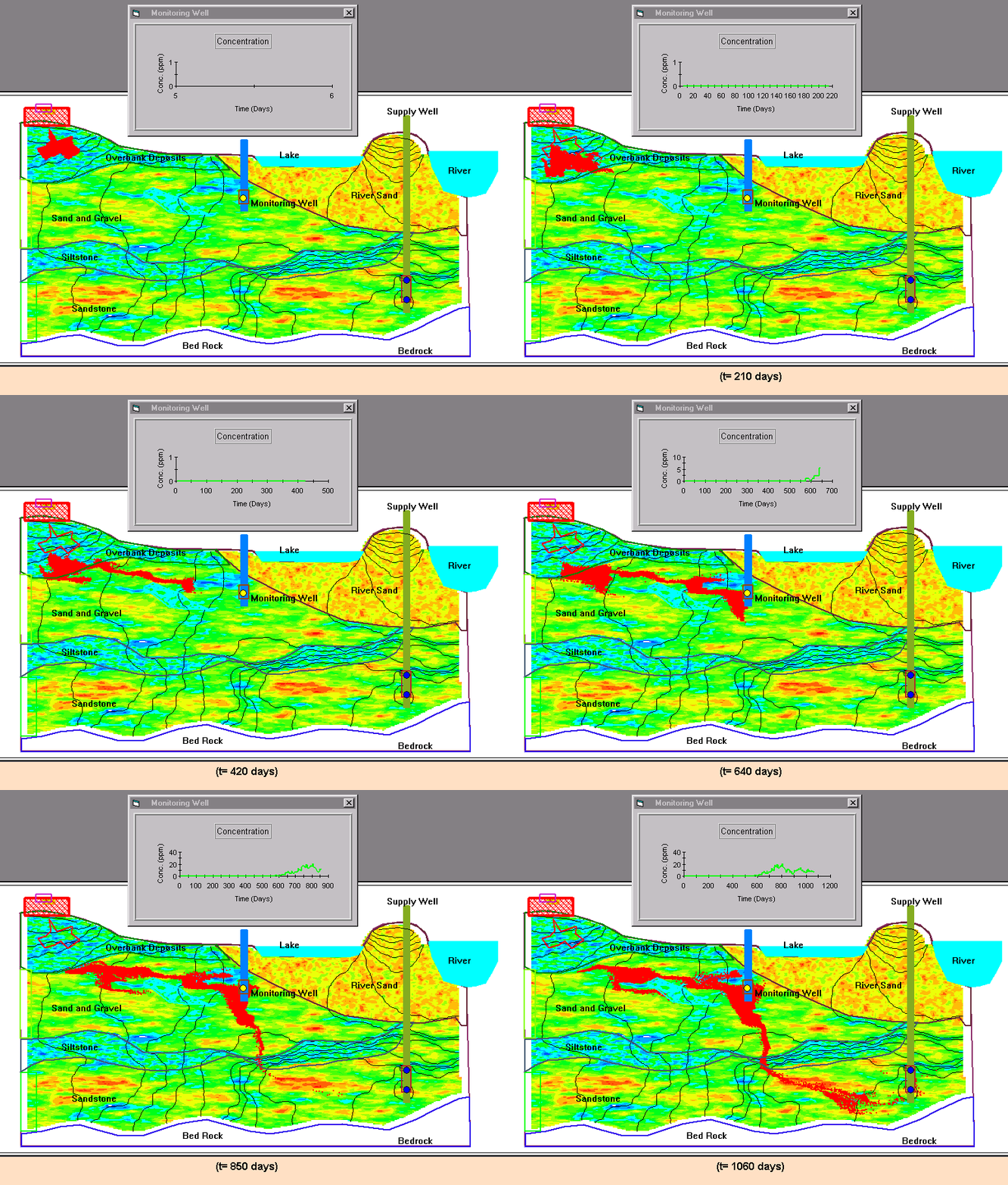 IGW-NET
Ruptured UST — a plume finds its way through everything
A ruptured underground storage tank releases a dense plume into a layered aquifer — shallow and deep, separated by a confining unit, all three layers honeycombed with small-scale heterogeneity. Downstream, a river's channel deposit cuts through every layer. A high-capacity well pumps from the deep aquifer. Watch the plume migrate, finger, and find a hole in the confining unit — pulled down through small-scale heterogeneity that traditional layer-only models would never reveal.
-
SwaNET + IGW-NET
Stream–aquifer dynamics — when frequency matters as much as proximity
Three parallel simulations of the same scene: a river rises and falls with daily, storm, or seasonal rhythms, and an unconfined aquifer beside it responds — or doesn't. The mechanism is hydraulic diffusivity, the ratio of transmissivity to specific yield (T/Sy), with riverbed sediments adding another resistance. Watch how the same river drives three very different bank-storage dynamics across the parallel cases. Sometimes a bank close to the river barely responds; sometimes a distant one shows large oscillations. Frequency matters as much as proximity. Counterintuitively, the rapid swings — flash floods, daily ripples — often barely reach the interior at all. The aquifer acts as a low-pass filter on river forcing: slow oscillations propagate, fast ones are smoothed out before they get there. Change T, Sy, the forcing period, the bed conductance — see the response shift in real time. This is what real-time visual computational experiments make possible: not a single answer, but a parameter space you can explore.
-
IGW-NET
Transport across multiple scales of heterogeneity
Real aquifers contain heterogeneity at every scale at once — pore, lamina, lens, formation. Watch a plume sample all of them simultaneously.
-
IGW-NET
Probabilistic transport, in real time
Run the same scenario over hundreds of equally plausible aquifers. The plume becomes a probability cloud — most likely here, possibly there, almost never over there.
-
IGW-NET
Well capture — advection meets Brownian motion
Particles advect toward a pumping well along streamlines. Brownian motion adds the molecular jitter. Together they trace the true capture zone.
-
IGW-NET
A chemical spill, hour by hour
From a point source to a moving plume. The model takes you from the moment of release through migration, dispersion, and arrival at receptors.
-
IGW-NET
Industrial spill — advection, diffusion, dispersion
Three transport mechanisms, decomposed and shown together. Watching them stack up is the clearest possible introduction to contaminant fate and transport.
-
IGW-NET
Leaky waste pond meets fractured till
On paper, a clay till looks like a perfect liner. In reality it is laced with fractures and sand pockets that move contaminants far faster than diffusion calculations predict.
-
IGW-NET
Where groundwater surfaces — multiple sources
Springs, seeps, gaining streams, baseflow — all of these are groundwater becoming surface water. Watch the platform trace each one back to its source aquifer.
-
IGW-NET
Freshwater injection in a brackish aquifer
Aquifer storage and recovery: inject freshwater, store it underground, withdraw later. Watching the bubble dynamics shows how much of what went in actually comes back out.
-
IGW-NET
Seepage under a dam — finding the clay lenses
A dam's safety depends on what is hidden under it. The simulation reveals how thin clay lenses redirect seepage paths and where pressures concentrate.
What you're looking at.
Groundwater is invisible. For a century, hydrogeologists have carried mental models of what aquifers do — pictures in their heads of how water flows, how plumes spread, how wells respond. The pictures were never executable.
MAGNET4WATER changes that. Above, a library of synthetic simulations — each built in IGW-NET in minutes, each running in real time. Open one, change the parameters, watch your intuition either confirmed or recalibrated. This is what mental models look like when you can run them.
Ready to build your own?
Every simulation above was built in IGW-NET like a sketch on an interactive notepad. Open the platform and try it — no installation, runs in your browser.